100% Pass Quiz F5 - F5CAB1 Newest Exam Cost
Wiki Article
The product is made in three different formats to help customers with different preparation styles meet their needs. One of these formats is F5 F5CAB1 Dumps PDF file which is printable and portable. Users can take BIG-IP Administration Install, Initial Configuration, and Upgrade (F5CAB1) PDF questions anywhere and use them anytime.
F5 F5CAB1 Exam Syllabus Topics:
| Topic | Details |
|---|---|
| Topic 1 |
|
| Topic 2 |
|
| Topic 3 |
|
| Topic 4 |
|
| Topic 5 |
|
Exam F5CAB1 Material | F5CAB1 Reliable Exam Cram
You may find that on our website, we have free renewal policy for customers who have bought our F5CAB1 practice quiz. You can enjoy one year free updated service. This policy greatly increase the pass percentage of the candidates if they can't pass in one time or in the limited date. And they can enjoy 50% off if they buy them again one year later. All in all, our service is completely considerate. Come to experience our F5CAB1 Training Materials.
F5 BIG-IP Administration Install, Initial Configuration, and Upgrade Sample Questions (Q59-Q64):
NEW QUESTION # 59
The monitoring team reports that the SNMP server is unable to poll data from a BIG-IP device.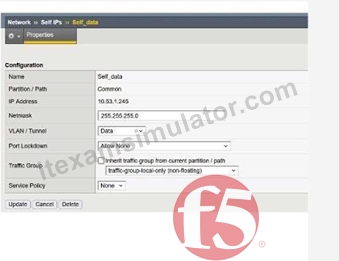
What information will help the BIG-IP Administrator determine whether the issue originates from the BIG-IP system?
- A. The configuration on the exhibit is correct and other options should be explored.
- B. The "Port Lockdown" setting is preventing the SNMP server from polling data from the BIG-IP.
- C. The "Traffic Group" setting must use a floating Traffic Group.
- D. The "VLAN / Tunnel" setting must allow All Vlans.
Answer: B
Explanation:
The exhibit shows a Self IP with:
VLAN: Data
Port Lockdown: Allow None
Impact of "Allow None" on SNMP
When a Self IP is configured with:
Port Lockdown: Allow None
the BIG-IP blocks all services and ports except a few hardcoded HA communication ports.
This means:
UDP/161 (SNMP) is blocked
UDP/162 (SNMP traps) is blocked
The SNMP server cannot poll or receive data from the BIG-IP through this Self IP SNMP relies on access through the Self IP if out-of-band (mgmt interface) is not used.
Thus, the issue is directly caused by Port Lockdown = Allow None, which prevents SNMP communication.
NEW QUESTION # 60
Refer to the exhibit. What traffic will be permitted to reach the BIG-IP?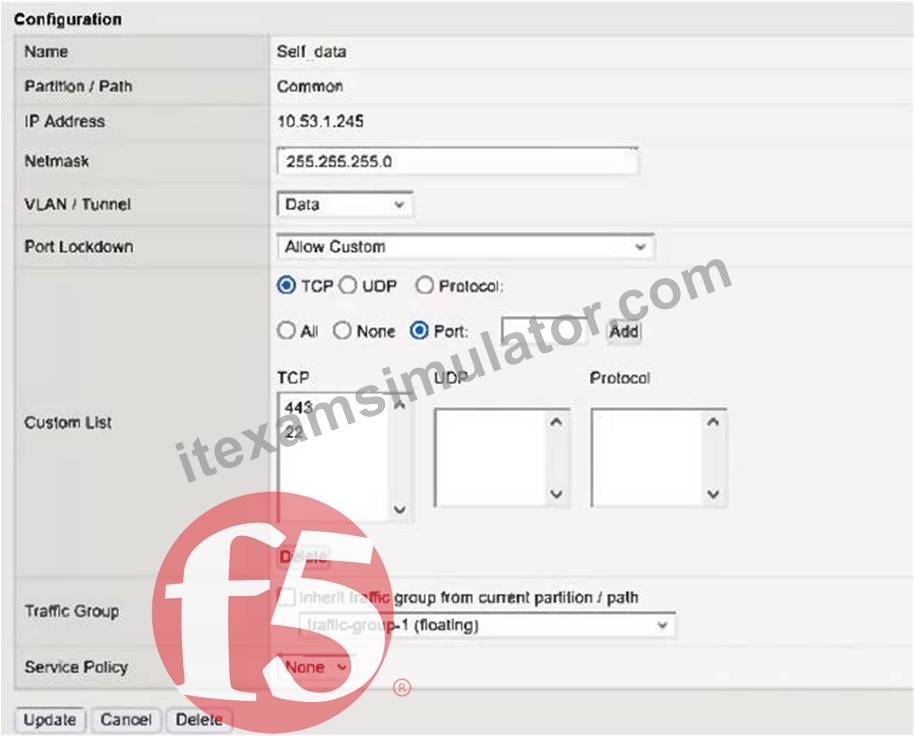
- A. Telnet
- B. FTP
- C. SSH
Answer: C
Explanation:
The exhibit shows the configuration of a Self IP with:
Port Lockdown: Allow Custom
A Custom List that includes the following TCP ports:
443
22
Meaning of these ports:
TCP 443 -> HTTPS (TMUI -- web-based management)
TCP 22 -> SSH (command-line remote access)
No other TCP, UDP, or protocol entries are listed; therefore, only these two services are allowed to reach the BIG-IP via this Self IP.
Evaluating the answer choices:
Option Service Port Allowed?
Not allowed
FTP TCP 21 Not listed
Allowed
SSH TCP 22 Listed
Not allowed
Telnet TCP 23 Not listed
Thus, SSH is the only traffic permitted through this Self IP configuration.
NEW QUESTION # 61
The BIG-IP Administrator received a ticket that an authorized user is attempting to connect to the Configuration Utility from a jump host and is being denied.
The HTTPD allow list is configured as:
sys httpd {
allow { 172.28.31.0/255.255.255.0 172.28.65.0/255.255.255.0 }
}
The jump host IP is 172.28.32.22.
What command should the BIG-IP Administrator use to allow HTTPD access for this jump host?
- A. modify /sys httpd allow add { 172.28.32.22 }
- B. modify /sys httpd allow delete { 172.28.31.0/255.255.255.0 172.28.65.0/255.255.255.0 }
- C. modify /sys httpd allow replace-all-with { 172.28.32.22 }
Answer: A
Explanation:
The HTTPD allow list controls which IP addresses or subnets may access the Configuration Utility (TMUI) on the BIG-IP system. The Administrator already has two subnets allowed and needs to add a single host IP to the existing list.
The object /sys httpd allow supports actions such as add, delete, and replace-all-with.
Because the goal is to add one more entry without removing the existing permitted subnets, the correct command is:
modify /sys httpd allow add { 172.28.32.22 }
This appends the new host to the existing list while preserving the previously configured networks.
NEW QUESTION # 62
For an upgrade of a standalone BIG-IP, a maintenance window is available in which brief interruptions are allowed.
Actions with no impact can be done outside the maintenance window.
When should a license reactivation be performed?
- A. Before the maintenance window.
- B. After the maintenance window.
- C. During the maintenance window.
Answer: A
Explanation:
License reactivation updates the BIG-IP device's license file to ensure:
* TheService Check Dateis current
* The device is eligible to install the intended TMOS version
* Any module entitlement updates are received
Reactivationdoes not interrupt trafficand does not require a reboot, making it safe to performbeforethe maintenance window.
F5 best practices state:
* Performall non-impact tasks priorto the scheduled maintenance window
* Leave the window available for activities that require rebooting, such as the software installation itself Since license reactivation isnon-disruptive, it should be donebeforethe upgrade window starts.
NEW QUESTION # 63
The BIG-IP Administrator uses Secure Copy Protocol (SCP) to upload a TMOS image to the/shared/images/ directory in preparation for a TMOS upgrade.
After the upload is completed, what will the system dobeforethe image is shown in the GUI under:
System - Software Management - Image List?
- A. The system verifies the internal checksum
- B. The system copies the image to /var/local/images/
- C. The system performs a reboot into a new partition
Answer: A
Explanation:
When a TMOS image (.iso file) is uploaded into the/shared/images/directory, the BIG-IP performs an internal validation step before the ISO appears in the GUI.
1. The system verifies the internal checksum
* BIG-IP automatically reads the embedded checksum inside the ISO file
* Verifies integrity of the uploaded image
* Confirms the file is not corrupted or incomplete
* Ensures the image is a valid F5 TMOS software image
Only after this checksum verification succeeds does the image appear under:
System # Software Management # Image List
Why the other options are incorrect:
A). The system performs a reboot into a new partition
* Uploading an ISO file never triggers a reboot.
C). The system copies the image to /var/local/images/
* All valid TMOS images remain in/shared/images/.
* No copying occurs.
NEW QUESTION # 64
......
In the matter of quality, our F5CAB1 practice engine is unsustainable with reasonable prices. Despite costs are constantly on the rise these years from all lines of industry, our F5CAB1 learning materials remain low level. That is because our company beholds customer-oriented tenets that guide our everyday work. The achievements of wealth or prestige is no important than your exciting feedback about efficiency and profession of our F5CAB1 Study Guide.
Exam F5CAB1 Material: https://www.itexamsimulator.com/F5CAB1-brain-dumps.html
- Pass Guaranteed Quiz 2026 F5 F5CAB1: Newest Exam BIG-IP Administration Install, Initial Configuration, and Upgrade Cost ???? Open ⏩ www.exam4labs.com ⏪ and search for 《 F5CAB1 》 to download exam materials for free ????Online F5CAB1 Test
- Pass Guaranteed Quiz 2026 F5 F5CAB1: Newest Exam BIG-IP Administration Install, Initial Configuration, and Upgrade Cost ???? Open ⮆ www.pdfvce.com ⮄ and search for ⮆ F5CAB1 ⮄ to download exam materials for free ????Interactive F5CAB1 Practice Exam
- 100% Pass 2026 Latest F5CAB1: Exam BIG-IP Administration Install, Initial Configuration, and Upgrade Cost ???? Search for { F5CAB1 } and easily obtain a free download on { www.pass4test.com } ????Valid F5CAB1 Test Simulator
- 100% Pass 2026 Latest F5CAB1: Exam BIG-IP Administration Install, Initial Configuration, and Upgrade Cost ???? Simply search for 《 F5CAB1 》 for free download on ▛ www.pdfvce.com ▟ ????Exam Vce F5CAB1 Free
- F5CAB1 Valid Test Notes ???? Dumps F5CAB1 Reviews ???? Exam Vce F5CAB1 Free ???? Search for ➠ F5CAB1 ???? and easily obtain a free download on { www.prepawayete.com } ????Interactive F5CAB1 Practice Exam
- F5 F5CAB1 the latest exam practice questions and answers ???? Search for ➥ F5CAB1 ???? on ⇛ www.pdfvce.com ⇚ immediately to obtain a free download ????F5CAB1 Exam Questions
- Pass Guaranteed Quiz 2026 F5 F5CAB1: Pass-Sure Exam BIG-IP Administration Install, Initial Configuration, and Upgrade Cost ???? Open ➤ www.prep4sures.top ⮘ enter ▷ F5CAB1 ◁ and obtain a free download ????Latest F5CAB1 Questions
- Exam F5CAB1 Registration ???? Valid F5CAB1 Test Simulator ???? Certification F5CAB1 Dumps ???? Search on 【 www.pdfvce.com 】 for ⇛ F5CAB1 ⇚ to obtain exam materials for free download ????F5CAB1 Latest Dumps Book
- Free PDF Quiz 2026 F5 Unparalleled Exam F5CAB1 Cost ???? The page for free download of ( F5CAB1 ) on ⮆ www.vce4dumps.com ⮄ will open immediately ????F5CAB1 Authorized Exam Dumps
- Latest F5CAB1 Questions ???? Exam Vce F5CAB1 Free ???? Interactive F5CAB1 Practice Exam ???? Download ➥ F5CAB1 ???? for free by simply entering ✔ www.pdfvce.com ️✔️ website ????F5CAB1 Answers Free
- Pass Guaranteed Quiz 2026 F5 F5CAB1: Newest Exam BIG-IP Administration Install, Initial Configuration, and Upgrade Cost ???? Search for ▛ F5CAB1 ▟ and obtain a free download on ➡ www.prepawaypdf.com ️⬅️ ????F5CAB1 Exam Cost
- haarislokx470585.thelateblog.com, aoifetzoq587931.webbuzzfeed.com, socialmediaentry.com, www.stes.tyc.edu.tw, thebookmarknight.com, tesstwbz874882.thenerdsblog.com, albiepjsi297578.bloguerosa.com, www.stes.tyc.edu.tw, roxannkbgv038309.gynoblog.com, imanitraining.com, Disposable vapes